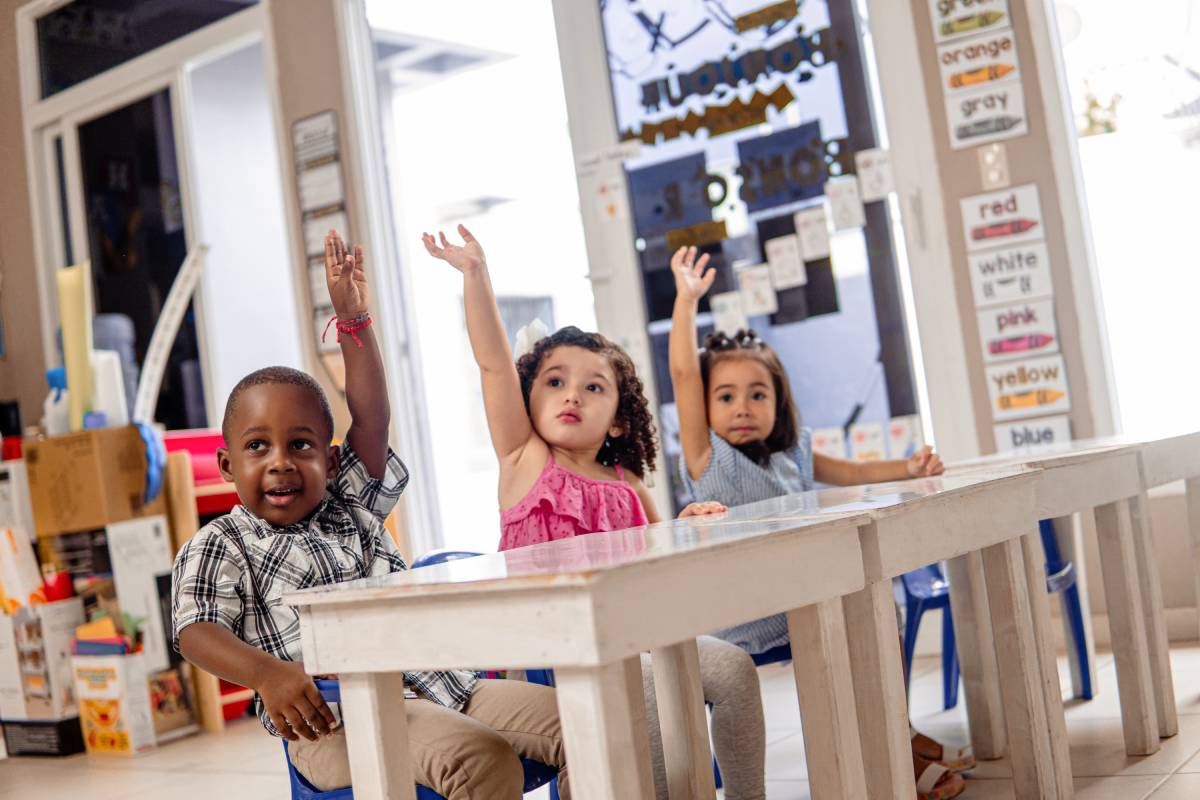
Three little children with your hands up in a class.

Key Differences Between Pre-K and Preschool

Parenting is filled with countless important decisions, including choosing the right early education center for your little one. In your search for appropriate child care, you’ve probably noticed the words Pre-K and preschool being used interchangeably. This can confuse some parents about which program is the best fit. Both options provide learning experience during those crucial years of development, but they are designed for separate age groups, educational goals, and developmental milestones in mind. To make the right choice for your child, knowing the differences between traditional preschool and pre-k programs goes a long way. 

Age Requirements

Preschool and Pre-K offer early childhood education to young children in a structured environment designed for learning. The key difference lies in the children’s ages. Preschool encompasses a broader age range, typically from 2.5 to 4 years old. After potty training is complete, preschool-aged children can attend for multiple years before making the transition to kindergarten. 

Pre-K is specifically designed to help children ages 4 and 5 prepare for kindergarten the following school year. This academic milestone serves as the final stepping stone before your child’s formal education begins. The age specificity of Pre-K creates a uniform classroom environment structured to support the development of children at similar developmental stages.

Learning Objectives

Preschool programs thrive on learning through play with a particular focus on social development and basic skills. The curriculum centers on fundamental concepts like colors, shapes, letters, and numbers through hands-on activities, creative play, and exploration. Pre-K programs follow a structured curriculum that aligns with kindergarten standards. Play is still important in Pre-K, but it also introduces more formal learning activities, such as reading, basic math concepts, and writing practice. 

Structure and Schedule

Preschools are far more flexible with their scheduling. Often consisting of both half and full day options, with options for care from two to five days a week. This ensures that various family schedules can be accommodated and separation can be gradually increased. Pre-K programs follow a more traditional school schedule, often following along the local elementary school calendar. Most pre-k programs operate 5 days a week and closely follow the K-12 structure. This unified schedule helps your child adapt to kindergarten’s routine so they aren’t thrown in all at once. 

Choosing the Right Program for Your Child

Choosing between preschool and pre-K depends on your child’s developmental stage and your family’s needs. Preschool offers a gentle, play-focused environment that gives them time to build confidence and social skills without the pressure of preparing for kindergarten. Pre-K offers an important foundation of academic skills and classroom routines they’ll need when they finally start kindergarten. Many parents opt to do both. Starting with preschool and transitioning to pre-K the year before kindergarten. The best program for your child is the one that fits your needs, aligns with your child’s development, personality, learning style, and preparedness level, and fits within your budget. No matter which program you choose, both will provide extra support in their development and social skills. Being a parent is a really tough job, and many parents struggle with concerns about whether they are making the right choices for their children. The decision doesn’t have to be as complicated as it seems. If you take the right approach and ask the right questions, you’ll find the program that perfectly aligns with the goals you and your child have set. 

As you explore early education options, remember that both preschool and Pre-K play important roles in helping children learn and grow. If you’re still unsure which program is the best fit, our team is here to help guide you. Considering Pre-K or preschool? Call now to learn more and find the right place for your child. 
Featured image for What Is the Best Age to Enroll Kids in Montessori Schools?

What Is the Best Age to Enroll Kids in Montessori Schools?

Featured image for What Is the Best Age to Enroll Kids in Montessori Schools?

Every parent naturally wants to give their child the very best possible start in life, and when it comes to education, that means exploring many different approaches. One of these approaches is Montessori, a method designed to nurture independence, curiosity, and a lifelong love of learning. While an excellent teaching method, its success often hinges on timing. That being said, what is the best age to enroll kids in Montessori schools?

It’s an important factor that could influence your child’s entire learning, so let’s dive into timing, how such early experiences shape their future, and what to consider as you plan your child’s educational path. 

What Is the Best Age to Enroll Kids in Montessori Schools?

When asked, most Montessori educators will agree that the best time to enroll your child in a Montessori-style environment is between the ages of 2.5 and 3 years old. This age range marks a key developmental window when children begin to desire autonomy and engage in more hands-on exploration, which are core tenets of the philosophy. 

Montessori classrooms are intentionally structured to meet the developmental needs of this age group right where they are. By starting during these years in particular, children not only absorb academic skills more quickly and easily, but they also build foundational habits such as focus, self-direction, and social interaction. While older children can still benefit from and even thrive in Montessori, early exposure helps them internalize the values and teachings more naturally and effectively. 

Why Earlier Is Often Better in Montessori Settings

The beauty of the Montessori approach lies in its ability to support a child’s development during what Maria Montessori called the “sensitive periods,” phases during which a child is particularly receptive to acquiring certain skills.

By enrolling your child around the age of 3, they are exposed to a learning environment tailored to their “right there and then” developmental needs. They can start engaging in purposeful play, practicing independence, and developing early literacy and math concepts organically. Starting early also helps children adjust to the structure and flow of the Montessori school environment while building deep, long-term relationships with their teachers and peers.

Toddler Programs Offer Gentle Transitions

Some families choose to enroll their children even earlier than the standard 2.5 to 3 years, often between 18 months and 2.5 years, through toddler programs. These early-action Montessori-inspired settings help emphasize emotional security, basic motor skills, and early language development.

While younger toddlers may not yet be ready for the full range of Montessori activities, these programs provide a gentle, nurturing introduction to the routine, independence, and socialization that will define their future school experience.

What If My Child Is Older Than 3?

Luckily, the Montessori method is designed to accommodate a wide range of learners, and many children join later with great success. If your child is 4, 5, or even entering the elementary years, rest assured that it’s not too late to benefit from Montessori education.

Older children may require a brief adjustment period to become accustomed to the self-directed structure, but the philosophy’s emphasis on respect, curiosity, and meaningful work resonates at every stage. In fact, joining a Montessori classroom later can often help a child who has become disengaged in traditional school settings.

Multi-Age Classrooms Encourage Peer Learning

One of the strengths of Montessori education is the use of multi-age classrooms, where younger and older children learn alongside each other. This structure benefits students regardless of when they enter the program.

Older children naturally assume leadership and mentorship roles, while younger ones observe and learn from their more experienced peers. This dynamic fosters confidence, collaboration, and a strong sense of community—qualities that serve children well throughout their lives.

Look for Signs of Readiness, Not Just Age

While age is a helpful guideline, it’s also important to consider your child’s readiness. Are they showing signs of independence? Are they curious, observant, or eager to participate in daily tasks? These cues can signal a good time to start, even if your child is slightly younger or older than the typical age of entry.

Every child develops at their own pace, and Montessori education is flexible enough to honor that. When children enter at a time that aligns with both their developmental stage and emotional readiness, they’re more likely to thrive.

Ready to Enroll or Learn More?

Contact Future Minds Montessori today to explore our thoughtfully designed programs and schedule a tour. We’ll help you find the perfect starting point for your child’s Montessori journey.

Featured image for How to Choose Montessori Tools

How to Choose Montessori Toys

How to choose Montessori toys is one of the most common questions parents ask when they first start exploring a Montessori education. After all, toys are so much more than just a way to keep children entertained. They’re also a key tool for development, and with that in mind, they need to be carefully chosen to align with how children naturally learn: through movement, exploration, and hands-on experience. 

Whether you’re building a home environment that supports Montessori principles or simply want toys that do more than flash and beep, understanding how to select them can make all the difference in your child’s growth. Let’s dive right in so you can start picking Montessori-style toys with confidence. 

How to Choose Montessori Toys Based on Core Montessori Principles

Montessori toys differ from mainstream options in a few key ways. They are designed to be simple, purposeful, and rooted in reality. When choosing Montessori toys, look for items that are made of natural materials, isolate one skill at a time, and encourage independence.

You want toys that are beautiful but not overwhelming and ideally made of wood, metal, or fabric instead of plastic. They should teach cause and effect, invite repetition, and help develop concentration. Rather than overstimulating a child with flashing lights or loud sounds, Montessori toys allow the child to engage more deeply and meaningfully. This approach is woven into every element of Montessori education and should benefit the child on their learning journey.

Age-Appropriate Choices for Montessori-Aligned Toys

Choosing the right toy also means selecting one that suits your child’s age and developmental stage. In Montessori, this concept is known as “following the child,” or meeting children where they are to support their natural growth.

For infants, this might mean black-and-white visual mobiles or grasping toys that help build coordination. Toddlers benefit from toys such as stackers, shape sorters, and simple puzzles that promote fine motor skills and problem-solving abilities. As children grow older, toys can introduce early math, literacy, and practical life skills, such as pouring water, slicing wooden fruit, or using a screwdriver set.

These seemingly simple activities foster independence, confidence, and focus. They also mirror the kinds of hands-on learning that children experience daily in Montessori school environments.

Look for Toys That Promote Independence and Purpose

A foundational principle of Montessori education is helping children do things for themselves. This value should be reflected in the toys you choose.

Montessori toys should encourage your child to explore and complete an activity without needing constant adult intervention. That’s why you’ll often see toys that have a clear beginning, middle, and end. For example, a set of nesting cups or a ring stacker provides your child with a clear goal: to sort, arrange, or complete the set. There’s a natural reward in finishing the task, and no need for flashing lights or congratulatory sounds.

Avoid Overly-Themed or Passive Entertainment Toys

One of the easiest ways to spot a non-Montessori toy? It’s probably based on a popular cartoon, requires batteries, or does all the playing for your child.

While these kinds of toys may be fun in small doses, they don’t support the kind of deep, self-directed learning Montessori emphasizes. Characters and fantasy elements can sometimes distract from the real-world learning that helps children understand and relate to their surroundings.

Instead, choose toys that reflect reality, like miniature kitchen tools, realistic animal figurines, or child-sized cleaning sets. These allow children to mimic adult behavior in a safe and developmentally appropriate way.

Simplicity and Focus: Less Is More

A cluttered playroom filled with dozens of toys can be overwhelming for children. Montessori encourages minimalism, where fewer, better-selected toys allow for deeper concentration and longer playtime.

Maintain a rotation system by offering a limited number of toys at a time and switching them out periodically to keep interest high. Look for toys that isolate one concept, such as a puzzle that teaches matching or a set of beads for counting. Simplicity helps children stay focused and increases the likelihood of mastering each new skill before moving on to the next one.

This approach mirrors the structured yet flexible learning environment found in high-quality Montessori school programs, where materials are curated to support purposeful engagement.

The Role of Practical Life Toys in Learning

Some of the most powerful Montessori toys don’t resemble toys at all—they look like real tools. This is by design.

Practical life toys enable children to safely and developmentally supportively mimic adult tasks. Think of pouring pitchers, sweeping sets, or small gardening tools. These toys help children develop muscle memory, improve hand-eye coordination, and build confidence. Most importantly, they make children feel capable, which is one of the central goals of Montessori education.

By giving your child the tools to take care of themselves and their space, you’re helping them grow into independent, responsible individuals.

Take the Next Step Toward a Thoughtful Montessori Experience

Ready to learn more about how Montessori can enrich your child’s growth? Contact Future Minds Montessori to explore our school programs or schedule a tour today.

Featured image for What Are the 12 Core Early Childhood Education Units?

What Are the 12 Core Early Childhood Education Units?

Teaching comes with many challenges. Each grade level requires different competencies and, therefore, requires different and specific skills and knowledge from teachers. Early childhood education, for example, is one of the most sensitive and formative stepping stones of a child’s life because they are still in their most absorbent stage during that time. If you are considering a career in Early Childhood Education, you have probably heard of the 12 core units required to get started. These units are often the minimum academic foundation for working in licensed child care centers like Head Start programs, Preschools, and other early education centers in California and other states that follow the same standards. These are required to ensure that teachers have a strong understanding of child development, curriculum planning, and health and safety. But what are these 12 early childhood education units?

What Are the 12 Core Early Childhood Education Units?

Perhaps surprisingly, the twelve core early childhood education units do not refer to twelve individual principles that educators must complete for their teaching credentials. Rather, the units refer to course units that must be completed as part of a teacher’s education. Educational courses are typically 3-5 units—ECE units, in particular, are generally three each—so aspiring educators will complete approximately four courses to satisfy this requirement. The courses taken to satisfy ECE requirements are typically as follows.

Child Growth and Development (3 units)

This is the course that teaches how children grow physically, emotionally, and cognitively from the time they are born until around 8 years old. Developmental milestones, exploration of the theories of development by Piaget and Erikson, and the role of genetics and environment are included in the topics.

The topics covered help educators develop age-appropriate learning experiences and recognize delays early on.

Child, Family, Community (3 units)

The focus of this course is the relationships between young children, their families, and their communities. Future educators get to examine cultural diversity, family structures, and societal influences on child development.

It is important to build strong relationships with children in order to give them the best possible education. This also requires building relationships with their families and understanding their backgrounds so teachers can best support a child’s learning and overall well-being.

Introduction to Curriculum or Principles and Practices of Teaching Young Children (3 units)

In this class, future educators get to explore developmentally appropriate practices in early childhood education. They learn about topics on curriculum planning, learning environments, play-based learning, and the role of observation and assessment.

This course is intended to help educators design lessons and activities that promote learning while at the same time taking into consideration the unique needs of individual children.

Health, Safety, and Nutrition (3 units)

This course is where the students learn about promoting the physical health and safety of children in early learning setups. It covers various topics such as child abuse prevention, emergency preparedness, nutritional guidelines, and disease prevention.

This course ensures that the staff at early education centers are equipped to mentally and physically care for children in their centers and handle the pressure of caring for so many children at once in a closed environment. Ensuring a safe and healthy environment is a top priority and responsibility of any early childhood education center and provider.

Potential Variations

Most schools require that students take twelve units each semester. However, they may be packaged differently depending on how the program is designed. For example, in some schools, the health and safety course may be combined or counted slightly differently. Be that as it may, the essential content areas remain the same.

In addition, there are times when employers require more than just 12 units. For example:

  • 16 units may be required for lead teaching positions
  • Specialization units in infant toddler care/special education, or administration, may be required depending on the career path you plan to take.

Logistics

You can complete these 12 core units at 

  • Community colleges
  • Four-year universities
  • Accredited online programs
  • Vocational schools

After completion of the 12 units, you will then be qualified for entry-level positions such as:

  • Teacher Assistant or Teaching Aide
  • Associate Teacher (with experience)
  • Substitute Teacher in a preschool
  • Childcare worker in licensed centers

Completion also opens the door to further study in:

  • Associate degrees in Early Childhood Education
  • Bachelor’s degree in Childhood Development or related field
  • State certification or permits

More than just job eligibility and completing qualification requirements, these units can help you build confidence and provide you with a deeper understanding of how young children accumulate learning and how they grow. Many students also discover their passion for teaching while undergoing these courses of study, and the courses become launchpads for lifelong careers in education, child psychology, or child advocacy.

The Highest Standard of Care at Towne and Country Early Education Center

At Towne and Country Early Education Center, we believe in the power of well-prepared, well-qualified educators. So, if you are looking for a learning center where educators and assistant teachers are passionate and well-equipped to help in the education and development of preschool children, reach out to us today so you can discover how we can be your partner in supporting your little one.